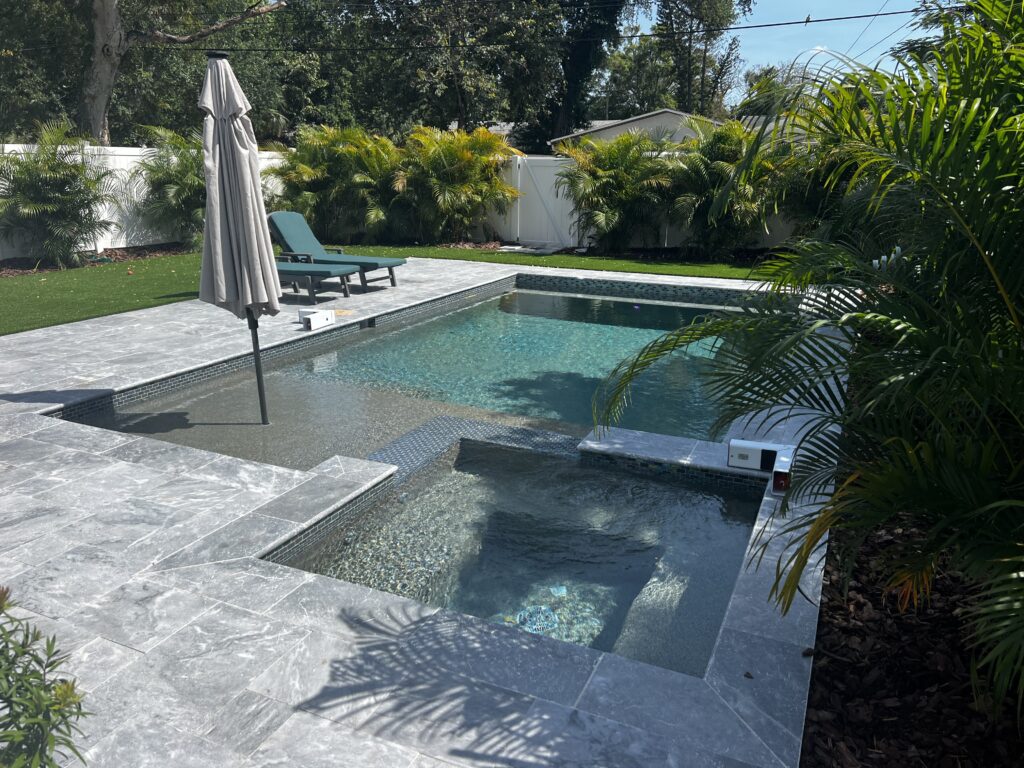
In St. Petersburg and surrounding communities, no two backyards are exactly the same, but they all have one thing in common: permitting and other approval steps may be required before building an inground pool. In both Pinellas County and Manatee County, local rules can affect your pool’s size, design, placement, timeline, and budget. This includes homes in St. Petersburg, Bradenton, Palmetto, Parrish, and nearby communities.
Experienced local pool builders like WinWay Pools know that the process is not one-size-fits-all. For example, a project inside the City of Bradenton may move through a different permitting path than a project in unincorporated Manatee County, and a home in Palmetto may have its own city forms, requirements, and floodplain review process. This is why the right conversations need to happen at the very beginning of a custom pool project.
Here is an overview of what your pool builder should cover with you before construction begins, so the pool-building experience is as seamless as possible.
Start With One Basic Question: Who Has Jurisdiction Over Your Property?
One of the first steps in a Florida pool project is confirming which local government has jurisdiction (authority) over your address. In the St. Petersburg area, permitting for properties inside the city generally goes through the City of St. Petersburg’s Building & Permitting system, while unincorporated Pinellas County and certain municipalities are served by Pinellas County Building and Development Review Services.
The same issue comes up in Manatee County. Many Parrish-area homes are in unincorporated Manatee County, where permitting and development services typically go through the County’s online services. But if the property is inside the City of Bradenton, the permit path runs through Bradenton’s Building and Permitting Division. And if the home is inside the City of Palmetto, the City of Palmetto has its own Building Department, forms, and online portal.
What does this mean for your new pool? Your home’s jurisdiction needs to be verified before applying for a permit. It is easy to assume “the county handles it,” when the actual authority depends on the property address. This is why experienced local pool builders spend time confirming jurisdiction early in the planning process.
Yes, a New Inground Pool Usually Requires a Permit
A new inground pool is not treated like a small backyard upgrade. It usually involves structural, electrical, and safety code requirements, plus a plan review and inspections. In Pinellas County, the County’s permit system specifically covers residential permits for projects such as pools and spas. In Manatee County, the County’s permitting office routes permit applications, plan reviews, and permit packages through its online portal. Bradenton and Palmetto direct applicants to city-specific permitting systems and documentation.
In practical terms, this means your pool builder usually needs more than a sketch. You and your custom pool builder need to be on the same page for your custom pool concept and the conditions of your lot (yard size, elevation, etc.).
Setbacks Are One of the Biggest Reasons Pool Plans Change
One of the most common early-stage issues in pool construction is setback compliance. A setback is the required distance between a structure or improvement and a property line, easement, or other regulated boundary.
In unincorporated Pinellas County, zoning and setback information is handled through the Pinellas County Zoning & Land Use resources. In unincorporated Manatee County, zoning is governed through the Manatee County Land Development Code.
Be aware that Manatee County’s pool requirements specifically require the site plan to show setbacks with dimensions. So if you’re building in a Parrish-area neighborhood that is outside city limits, your pool concept may need to move after the lot survey, zoning review, or utility layout is checked.
Inside the City of Bradenton or City of Palmetto, setback questions may route through city planning, zoning, and code resources instead of the county’s unincorporated land development process. Bradenton’s Planning & Zoning Division oversees development review, and Palmetto’s Planning & Zoning Department administers the city’s code and comprehensive plan.
Several factors can affect setback compliance, including:
- Your zoning district
- Lot dimensions and shape
- Corner-lot conditions
- Easements
- Pool equipment placement
- Whether the property is inside a city or in an unincorporated area
Note that according to Florida law, if your HOA does not provide specific setback limits, the applicable county or municipality has control over setbacks. Plus, while a backyard may seem large enough for a pool, there may be site constraints that affect what can actually be approved.
What does all this really mean? If you already have a rough backyard layout in mind, the exact pool location may need to shift once zoning, utility, and survey details are reviewed.
This is where a site-specific consultation with a qualified, local pool builder becomes valuable. Your builder is not just looking at available square footage; they are looking at access, grading, utilities, and all the things that can affect whether the original concept is actually buildable.
Pool Safety Also Impacts the Permit Process
Experienced Florida pool builders know that pool safety is built into the permitting process.
For example, under Florida’s Residential Swimming Pool Safety Act, a new residential swimming pool must have at least one approved safety feature to pass final inspection, such as a qualifying enclosure, an approved safety cover, exit alarms on doors and windows with direct pool access, certain self-closing and self-latching door devices, or an approved pool alarm.
The same law also states that a residential pool barrier must generally be at least four feet high, prevent a child from crawling under or climbing over it, and have gates that open away from the pool and are self-closing and self-latching.
These state requirements also show up in local permitting paperwork. So, whether your project is in St. Petersburg, Parrish, Bradenton, Palmetto, or unincorporated Manatee County, safety is not an afterthought. It is built into the permit path.
If Your Property Is in a Flood-Prone Area, Expect Another Layer of Review
Because so much of the Manatee County and Pinellas County area is coastal or low-lying, floodplain questions can affect your pool’s construction planning. If your property is located in a flood zone, additional building and site-planning requirements may apply. While a pool is not the same as a habitable structure, floodplain status can still affect project review, drainage considerations, equipment placement, and required documentation.
Pro tip: If you’re building a new home and a custom pool in the St. Petersburg area, the soil report of your property is essential. The report ensures that you are building to your land’s specific requirements, which helps safeguard and future-proof your home and pool.
HOA Approval Can Be Separate From City or County Approval
If your home is in a deed-restricted neighborhood or part of a homeowners’ association (HOA), you may need a separate review through an architectural review committee before pool construction begins.
As we noted earlier, Florida state law recognizes an HOA’s architectural control covenants and improvement review processes. If the HOA’s governing documents do not provide specific setback limitations, the applicable municipal or county setbacks apply instead. If an HOA denies a request, it must provide a written notice identifying the rule or covenant relied on.
Before pool construction can begin, you and your pool builder should review:
- Your HOA’s declaration of covenants
- Pool design guidelines
- Architectural review procedures
- Fence and screening requirements
- Equipment visibility rules
- Construction access or work-hour rules
The safest approach is to treat HOA approval as its own step in the process, not something to deal with once permit documents are already in motion.
Why Permit Planning Should Happen Before the Pool Design
Homeowners sometimes think permitting starts after the design is complete. In reality, permitting and site constraints must be evaluated before your custom pool’s design can take shape.
At WinWay Pools, we look at access, setbacks, zoning, flood-zone issues, barrier requirements, and HOA rules upfront, so we can design your custom pool with these conditions in mind. This leads to a smoother permitting experience and fewer midstream revisions and delays.
A Smart First Step for Building a Pool in the St. Pete Area
If you are thinking about building a new inground pool in St. Petersburg or nearby Pinellas County or Manatee County, one of the smartest first steps is to move beyond inspiration photos and start with a site-specific conversation with a local, custom pool builder.
Before finalizing your pool’s shape, size, finishes, or features, it helps to know:
- Which permitting office has jurisdiction.
- What zoning and setback rules apply to your lot.
- Whether your property has easement or utility constraints.
- If a flood-zone review may affect the project.
- If your HOA has a separate approval process.
- What safety features will need to be incorporated into the final plan.
This is where an experienced, local builder like WinWay Pools can add real value early. The goal is not just to design a beautiful pool; it is to design one that fits your property, your neighborhood, and the approval path required to build it.
If you’re considering investing in an inground pool in St. Petersburg, Parrish, Bradenton, Palmetto, or a nearby community, WinWay Pools can help guide you through every step. Contact us today to learn how we can make the permitting and pool-building process as seamless as possible.